
About the Book
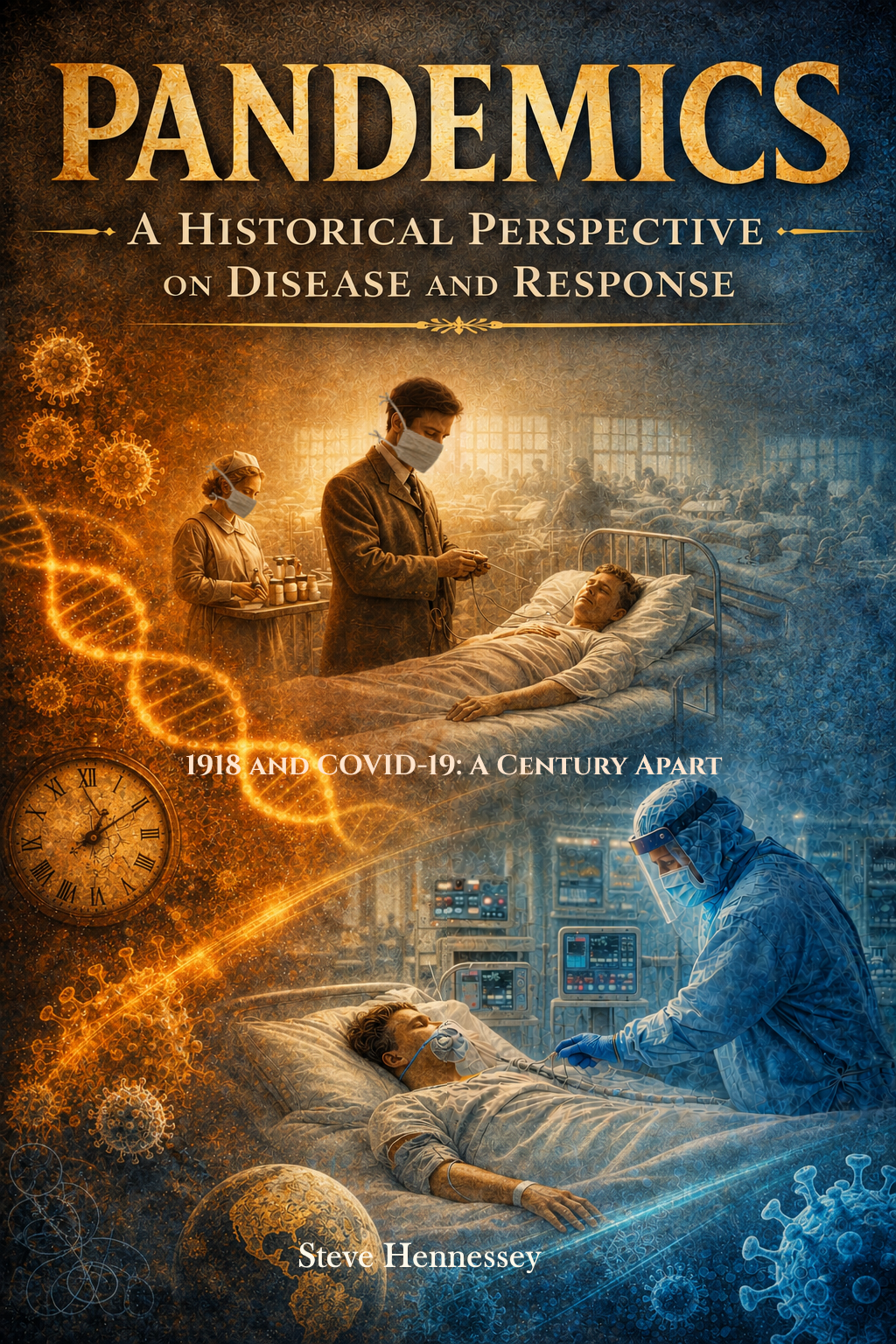
Pandemics are not only medical events. They are moments that reveal how societies understand disease, organize public health, and respond to uncertainty. *Pandemics: A Historical Perspective on Disease and Response* examines two of the most consequential global health crises of the modern era—the 1918–1920 influenza pandemic and COVID-19—to uncover enduring patterns in scientific progress, public response, and policy decision-making.
Because these were truly worldwide events, the book looks well beyond any single national experience. It presents the pandemics through the eyes of people living in different regions, cultures, and political systems. Drawing on a wide range of first-hand accounts preserved from the 1918 influenza pandemic—letters, diaries, nursing reports, and contemporary observations from many parts of the world—it places readers alongside those who lived through the crisis in real time. The same approach continues into the COVID-19 years, where numerous personal perspectives and accounts illuminate how individuals, families, and communities experienced the pandemic across different settings.
Rather than viewing these events solely through the lens of hindsight, the book reconstructs them as they unfolded. By 1918, medical science had advanced dramatically over the previous century. Germ theory was established, laboratory techniques were improving, and new treatments and diagnostic tools were emerging. Yet this knowledge was unevenly distributed. Many communities found themselves largely on their own, relying on the information and resources available to them. Government authorities didn't have ready-made plans, and without radio as a mass medium, official guidance and public understanding traveled slowly and unevenly.
A century later, the COVID-19 pandemic arrived in a world transformed by far more powerful tools, rapid information networks, and deeper scientific understanding. Knowledge and technology had advanced dramatically. And still, critical answers were missing. Government agencies struggled to keep pace with a novel virus, and societies once again confronted uncertainty, incomplete information, and the challenge of coordinating a coherent response—challenges that played out differently across diverse cultural and political settings.
By following experiences across regions and systems of governance, the book shows both how much has changed—and yet how familiar the fundamental problems remain. It explores virology and transmission, the evolution of public health systems, the ways governments communicate risk, and the human experience of prolonged crisis. Through careful historical analysis and clear scientific explanation, *Pandemics* connects past experience with present understanding.
Written for general readers, students, and anyone interested in history and public health, the book offers an evidence-based examination of disease and response across a century of global change—one that seeks not only to inform, but to convey the urgency and complexity of living through a pandemic as it happens.